
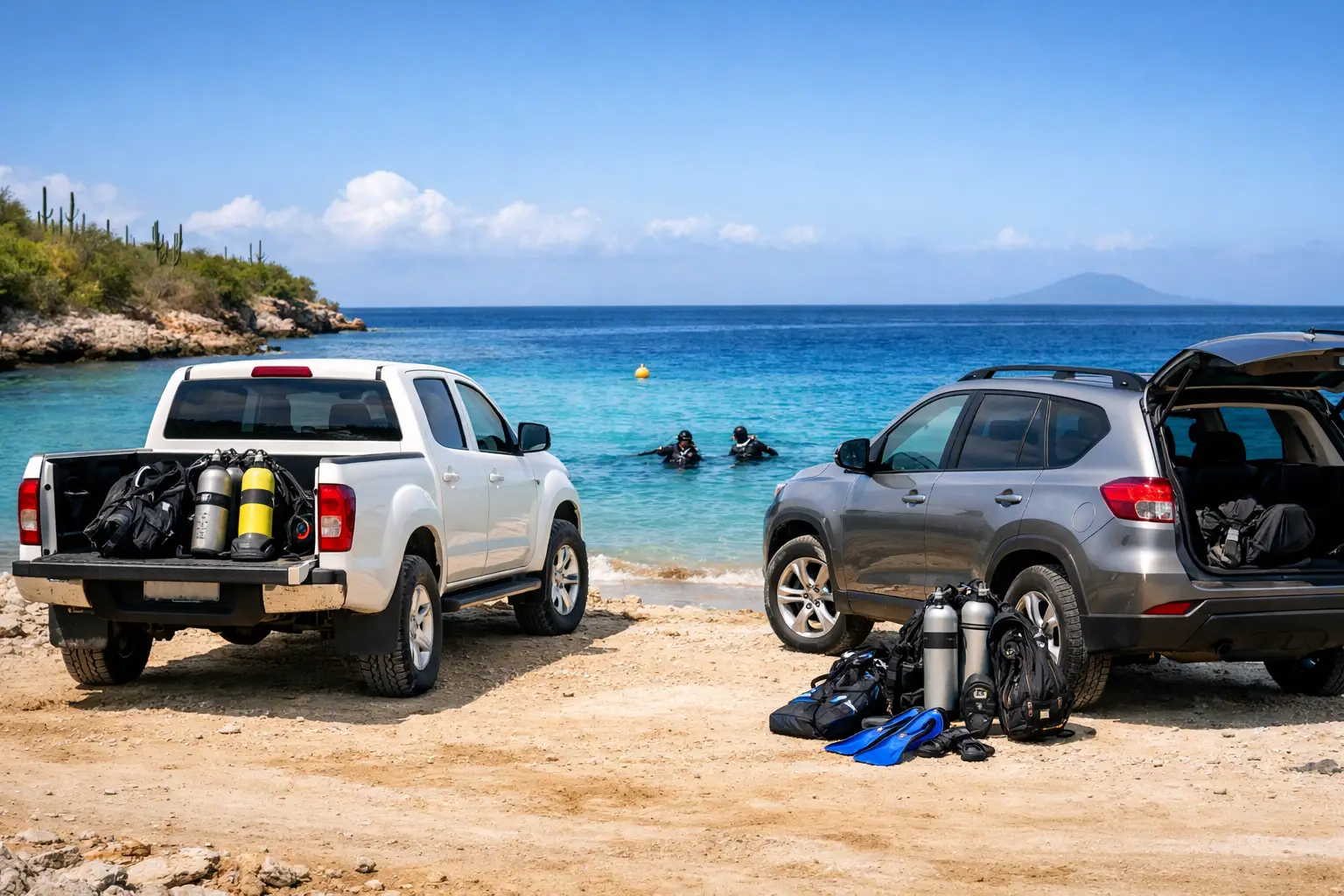

You feel the difference on day one. Two divers, four tanks, wet gear, a camera case, and a cooler can turn a simple airport pickup into a game of Tetris fast. That is why the pickup vs suv for dive trips question matters so much on Bonaire. The right vehicle makes shore diving easier, keeps your gear organized, and saves you from wasting time rearranging bags in the sun.
On this island, the choice is not just about style. It is about how you plan to dive, where you want to go, how many people are traveling with you, and how much gear you are carrying every day. Some visitors need the open utility of a pickup. Others are happier in an SUV with enclosed space and a quieter ride. Both can be great choices. The better one depends on your trip.
Pickup vs SUV for dive trips: what really matters
Most dive travelers start with cargo space, but that is only part of it. On Bonaire, you also want to think about how often you will load and unload tanks, whether you will visit rougher roads, how much sun and salt exposure your gear can handle, and how comfortable you want the drive to feel between sites.
A pickup usually wins on pure practicality for divers. Tanks, fins, BCDs, and rinse bins are easier to toss into a truck bed than they are to stack carefully inside a cabin. If you are doing multiple shore dives a day, that open layout feels simple and efficient. You can keep the messy stuff out of the passenger area and avoid riding around with wet gear pressed against your luggage.
An SUV, on the other hand, often feels better for mixed-use vacations. If your trip includes diving but also dinners in town, sightseeing, and longer drives with family or friends, an SUV gives you a cleaner separation between vacation comfort and dive logistics. Your gear stays enclosed, your seats stay drier, and the whole experience can feel more polished.
When a pickup is the better choice
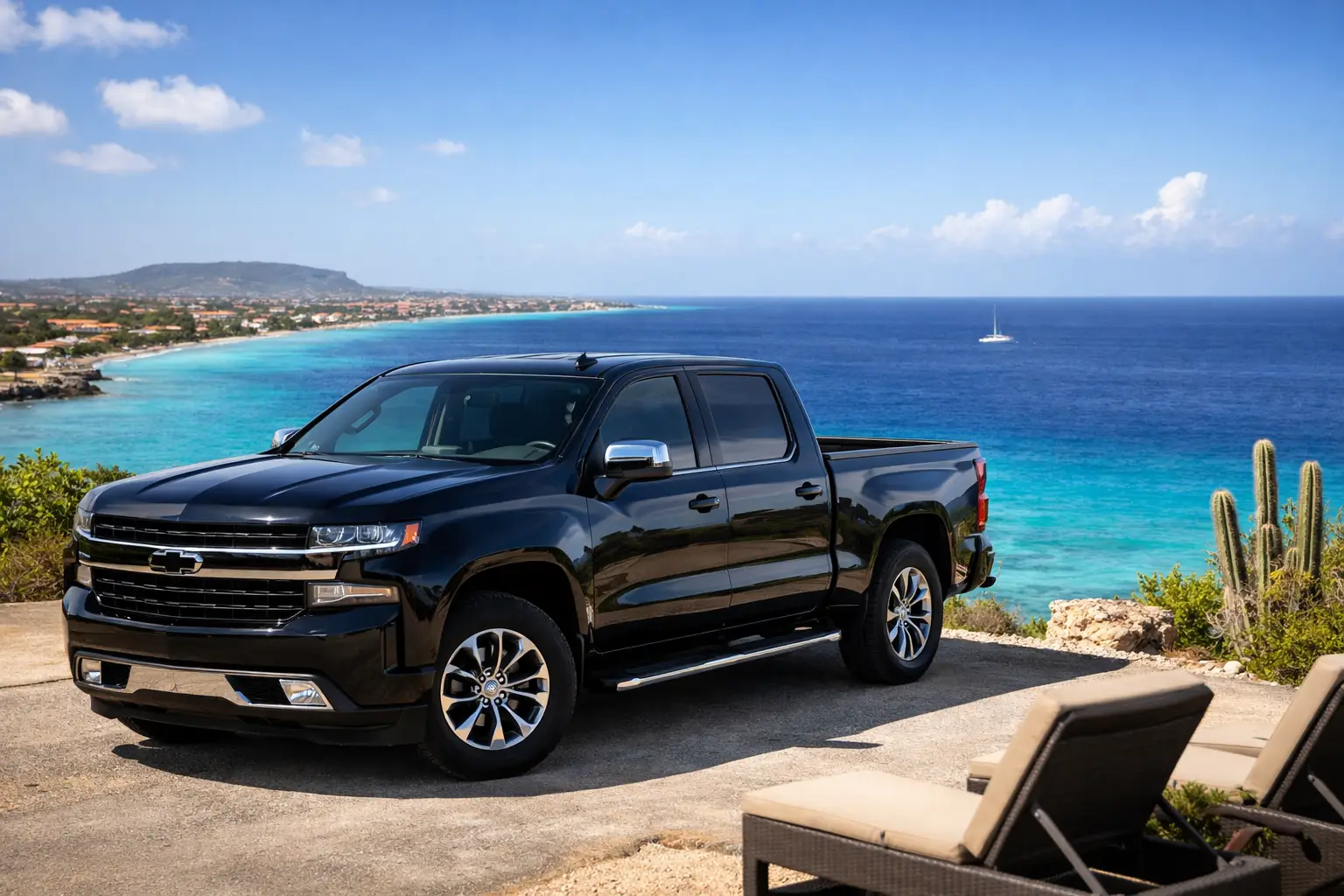
If your trip is built around shore diving, a pickup is usually the first vehicle to consider. Bonaire is famous for easy access to dive sites, and that means a lot of loading, unloading, and driving short distances with wet, sandy, salty equipment. A pickup handles that routine well.
The biggest advantage is convenience. Truck beds are made for awkward, heavy, damp gear. Tanks can sit securely without crowding passengers. Fins, booties, and mesh bags do not need to be packed around suitcases or camera backpacks. After a dive, you can put wet items in the back instead of turning the cabin into a drying room.
Pickups also make sense for groups. Two divers with light gear can manage in many vehicles, but three or four divers add up quickly. Once you include tanks, towels, snacks, dry bags, and maybe a few shore entry extras, space goes fast. A pickup gives you flexibility without forcing everyone to travel with bags on their laps.
There is also the road factor. If you plan to visit more rugged areas, including Washington Slagbaai National Park, a vehicle with more capability may matter. Not every traveler needs 4×4, but some routes and conditions are better matched to trucks and higher-clearance options. That is especially true if your idea of a good day includes remote sites and less pavement.
The trade-off with a pickup
The same open bed that makes a pickup useful can also be its drawback. Dive gear in the back is more exposed to sun, wind, and occasional rain. If you are carrying sensitive equipment like camera housings, lights, or dry bags with electronics, you will need to plan more carefully. Some travelers are perfectly happy doing that. Others would rather keep everything inside and out of sight.
A pickup can also feel less refined if your vacation is not all about diving. For some couples and families, a truck is perfect during the day but less appealing when heading out to dinner or spending an evening in town.
When an SUV is the better choice
An SUV works well for travelers who want versatility. You still get room for gear, but in a fully enclosed space. That matters if you are bringing more expensive dive equipment, want added security when making stops, or simply prefer not to leave gear exposed in a truck bed.
Comfort is another reason people choose an SUV. The ride can feel smoother and quieter, especially for travelers who split their time between dive sites, beaches, restaurants, and island exploring. If one person in your group dives and another does not, an SUV often lands in the sweet spot between function and everyday vacation use.
SUVs are also a smart fit for smaller dive setups. If you are traveling as a couple, diving casually rather than doing long gear-heavy days, and packing carefully, you may not need the open utility of a pickup at all. An SUV can give you enough room without feeling oversized.
The trade-off with an SUV
The main limitation is how quickly wet, sandy gear takes over the interior. Even with good organization, repeated shore dives mean loading damp equipment into an enclosed cabin. That can get messy. You may also find yourself lifting tanks into a higher cargo area or stacking gear more tightly than you would in a pickup.
For serious dive-focused groups, an SUV can start feeling full sooner than expected. What looks roomy on paper may feel different once everyone has fins, masks, towels, tanks, and personal bags.
Think about your group, not just the vehicle
This is where many renters make the wrong call. They picture the number of seats, not the real amount of gear. For dive trips, passenger count is only half the equation.
A couple doing one tank in the morning and spending the rest of the day relaxing may be completely comfortable in an SUV. A group of four doing multiple shore dives, carrying coolers and camera gear, will usually appreciate the breathing room of a pickup. Families can go either direction depending on how much of the trip is dedicated to diving versus general island time.
If your group tends to pack heavy, be honest about it. Bonaire makes it easy to be active all day, and active days come with extra stuff. It is better to have a little more room than to spend your vacation juggling gear between seats.
Pickup vs SUV for dive trips on Bonaire
Bonaire is a special case because driving and diving are closely tied together. You are not just driving to a marina and leaving your gear there. Many visitors move from site to site, enter from shore, and keep equipment with them throughout the day. That day-to-day rhythm is exactly why the pickup vs suv for dive trips decision deserves a little thought before you book.
If your plan is simple, mostly paved, and balanced between diving and vacation comfort, an SUV may be the better fit. If your plan is dive-heavy, gear-heavy, or includes rougher access roads, a pickup is often the more natural choice.
This is also where local guidance helps. A vehicle that looks ideal online may not be the best match once you factor in your group size, dive schedule, and where you want to go on the island. A local rental team can usually steer you toward the option that feels easiest once you are actually here.
The easiest way to choose
Ask yourself three questions. First, how much of this trip is really about diving? Second, how much wet and bulky gear will be with you every day? Third, do you want maximum utility or a more enclosed, comfortable ride?
If diving is the main event and gear management is your biggest concern, choose the pickup. If you want an all-around vacation vehicle that can still handle dive duty, choose the SUV. And if you are planning national park access or more rugged exploring, lean toward the more capable option from the start.
At Caribe Car Rental Bonaire, we help travelers make this decision every day because the best vehicle is the one that fits your trip, not just your reservation. A little planning before arrival goes a long way.
The good news is that there is no wrong answer between a pickup and an SUV if the vehicle matches the way you travel. Get that part right, and the rest of the island feels a whole lot easier.
 EN
EN  NL
NL